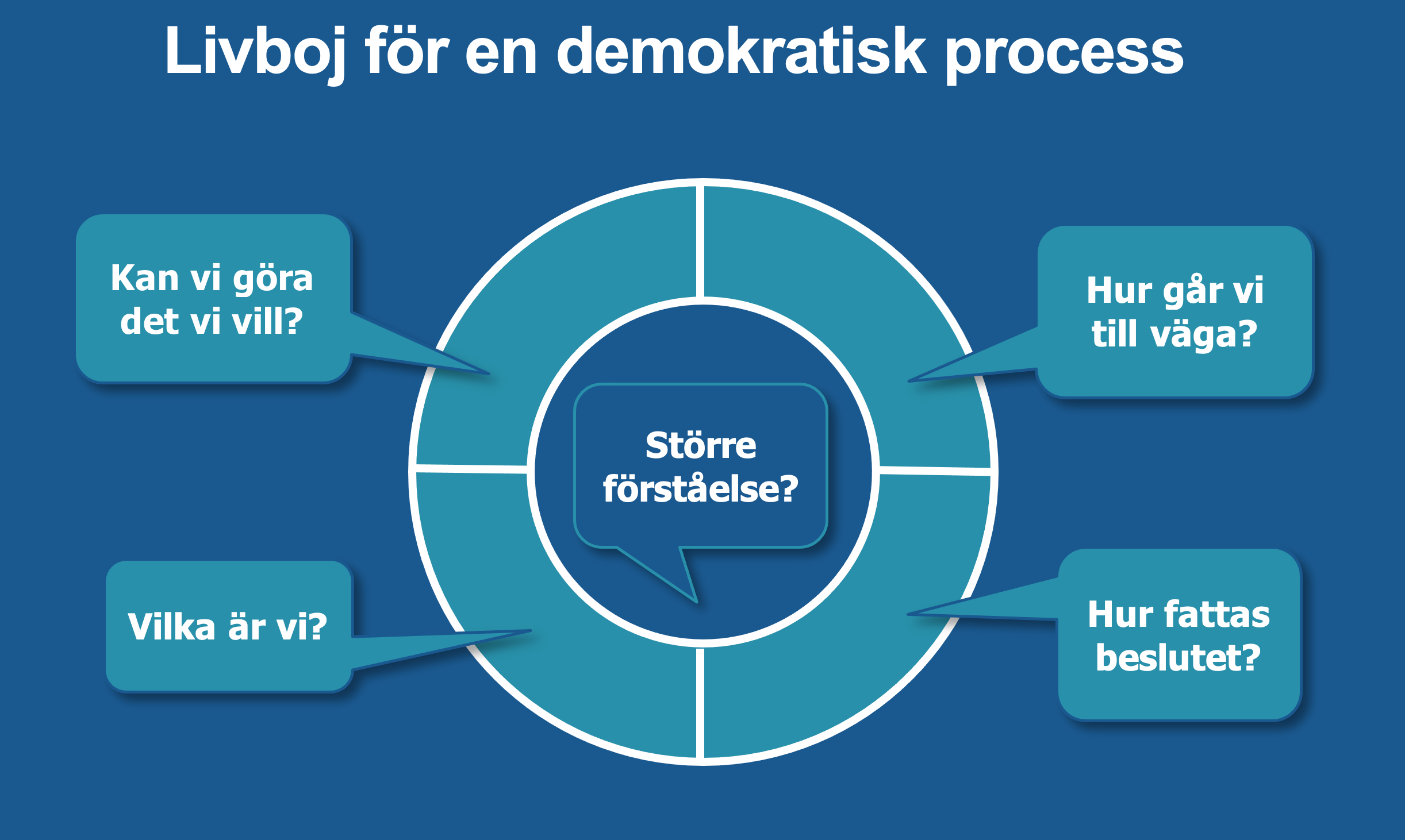
Print-out of the questions from Demometer, organisation. To be used at meetings and workshops.
Print-out of the questions from Demometer, meeting. To be used at meetings and workshops.
“The greatest use i have had of this material has been in grops of for example students and teachers, organisations, companies, pedagogues or unemployed people who for some reason have to to something together.
The material has been invaluable for giving us understanding of what it means to work in a group and why it can be useful to organise ourselves. Democratic Challenges gives us a common language to use when speaking about influence and participation. This is the perfect material for you if you are curious about how decisions and organisation really works.”
- Anders Holmberg, Kreaktiviteter
“The ABC of Democracy was a very appreciated part of a training program we arranged for 400 teachers and principals in Kurdistan. The country, which at the moment is going through great changes, needs serious support in order to build up a democratic civil society.Democracy.se is an important source for anyone who wants to open up a dialogue around the individuals role in the daily work to strenghten a democratic society.”
Asos Shafeek, Komak
“Using the ABC of Democracy you can talk about democracy in a way that people appreciate but aren’t always used to, which leads to many interesting discussions and new reflections.
The material is easy to understand and fits target groups of varying study experience and language backgrounds. I have held courses based on the ABC of Democracy for associations and personnel within ABF in Northern Greater Stockholm with Swedish, Spanish or Arabic speakers. The material gives a good base for understanding democracy and has very useful exercises.”
Eva Restrepo Ahrén, ABF Norra Stor-Stockholm
“I have used the material in the ABC of Democracy as a starting point in preparing for holding workshops in democracy,
fairness and human rights for associations and civil servants.”
- Jan-Erik Boström, DemokratiAkademin
“I have use for the model every day, to understand and explain in what ways our work with women’s rights in war zones contribute to peace and democratisation.”
- Pernilla Johansson, Kvinna till Kvinna
“OPEN SPACE has been great. In our youth commitment we had lots of use of this material. Speaking of myself, I have grasped more of the democratic principles”
- Birger Tuominen, Youth coordinator
The document contains all the methods and techniques presented here below.
The Academy for Democracy is a network of organizations focusing on civic training and educational programmes in the field of democracy and human rights.
A presentation is interrupted for a couple of minutes to allow the participants to discuss an issue in pairs.
See also the application Peter & Paul and the alternatives
In this background we:
- compare different types of organisation in terms of the ABC model’s alternative forms of rule and see which fundamental values have priority
- compare the extent to which different types of organisation meet the Lifebuoy’s criteria for democracy
- consider the possibilities for democratic management of meetings in different types of organisations
Different types of organisation – different forms of control
Companies and authorities
An organisation’s decision-making process is seldom, if ever, entirely democratic. In private business, for instance, authority is not shared equally; the employer appoints managers to direct and allocate work. Companies with many divisions tend to have a managerial hierarchy. The usual arguments are that operations must be directed efficiently and that managerial functions require special qualifications. Neither do the employees generally exert any influence on the appointment of executives; this is mostly a matter for the board of directors, which represents the largest shareholders.
Leadership in public administration and management has a similar structure, except that political bodies appoint the boards of national and local agencies. However, it may be membership rather than the nature of the operations that determines whether an organisation has some form of rule by experts as opposed to being based on democratic criteria. An example is companies that are owned by the employees, where there are less restrictions on the principles of Equal consideration and Personal autonomy.
Foundations
Foundations are an extreme case. Having no members, they cannot be democratic. Once the initial board has been appointed by the founders, it renews itself and is regulated by a memorandum of association that can only be amended in exceptional circumstances. Still, a foundation, although not democratic, is sometimes used for democratic purposes, for example to manage capital where the income goes to forms of development assistance that are controlled by the participants.
Associations
Working life is shaped by values like competence and efficiency, so the predominant form of control is guardianship or expert rule. Associations, on the other hand, have more room for the principles of Equal consideration and Personal autonomy.
Even the smallest associations usually have an executive committee. In an association that claims to be democratic, this committee must be directly accountable to the members at general meetings held at regular intervals. Thus it is the general meeting that is the highest decision-making body; each member’s interest merits equal consideration and no one – not even the chairman – has more authority than any other member to ultimately decide which interests are to have priority.
Large associations with financial resources often have employees. The general meeting can then be likened to a parliament, the executive committee to a government and the employees to national agencies that implement government decisions.
Networks
A network is an arena for collaboration and negotiation. It is an anarchic form of organisation that – unlike an association – does not make binding decisions, only voluntary agreements. The fundamental value is freedom: no one is obliged to participate in joint actions or projects against their will. A network is not a legal entity; it is not in a position to make binding contracts, represent anyone apart from the collaborators or make statements on behalf of others. Neither can a network be held accountable for its collaborators’ actions.
For example, the Academy for Democracy is a network whereby forty or so organisations voluntarily contribute ideas and money to a small secretariat that develops methods and training to promote issues to do with democracy. There is no membership; the organisations simply collaborate and each one decides whether to make a financial contribution, use the website’s calendar, engage the secretariat for training and get in touch with other collaborators for joint projects. Thus, the Academy for Democracy is not an organisation in its own right; it is a platform hosted by one of the collaborators: the cultural association called Ordfront. Ordfront is the organisation that is accountable for the secretariat’s budget and operations.
Types of organisation and the criteria for democracy
Inclusive membership – the central criterion
The absolutely crucial requirement is that everyone has an equal right to take part in decision-making. An association is democratic only if everyone is treated equally and respected as an autonomous individual – as an equal citizen. Any kind of discrimination is a breach of this requirement. Such tendencies can be countered in any organisation if its culture is to some extent influenced by the principles of Equal consideration and Personal autonomy.
In addition, however, the criterion of inclusive membership calls for certain formal institutions that are a feature of only some types of organisation. For example, all members must have an equal influence on procedures for appointing the board and the executives. If matters are not arranged in this way, the interests of some members will have more weight than those of others, which breaches the principle of Equal consideration.
An association may meet this requirement if it is open to all those who are affected by its operations and support its aims. Otherwise it will be more like an exclusive club that admits some people and keeps others out.
At the same time, the tokens of who is or is not a member must be clear and undiscriminating. Even if people are allowed to take part in certain activities without being a member, it must be possible to distinguish clearly between members (who have the right to take part in decision-making) and non-members. This is basically a question of power: the power base must be objective and clearly defined if it is to be shared. If the membership of some is dependent on the benevolence of others, the way will be open to nepotism and cliques.
A common solution is a membership fee. It obviously helps to finance operations but its most important function is to confirm membership: the voucher of my right to take part. This applies not least to the need for long-standing members to indicate at regular intervals that they still support the association’s aims and operations and are to be reckoned with in the future. Otherwise, when a crisis leads members to take sides on alternative proposals, ghosts from the past may exert an undue influence on decisions.
How well do different organisations comply with the Lifebuoy’s requirements?
The following chart compares how different types of organisation comply with the five criteria for democracy

Note that the criteria for membership and decision-making mainly concern the form of the process: one can tell whether an organisation is disqualified just by looking at its formal construction. On the other hand, it is not unusual for associations, for example, to fail the requirements because their rules are not followed in practice.
When it comes to participation and understanding, the Lifebuoy’s requirements focus on the quality of the decision-making process. It is possible to comply with these two criteria even in companies and public agencies even though decision-making in their formal organisation is dictated from the top.
Control of the agenda – the issues which an association has the authority to decide – has to do with limits imposed by the outside world. These limits are often diffuse, which is liable to result in power struggles and disputes about competence between associations at different levels.
Democratic management of meetings
Democracy at the organisational level is a question of more-or-less: Compliance with the Lifebuoy may be better for some requirements than for others. Even in a hierarchic organisation, feedback from employees to management can be improved (more efficient participation), just as decision-making procedures and powers can be clarified (better understanding). Much can be done above all to the culture of meetings.
Different types of meeting – different forms of control
Meetings tend to be seen as a necessary evil and are often run by force of habit. There is seldom a chance of discussing the purpose of a meeting and arriving at a suitable form:
- if it is just a matter of conveying information to the assembly, perhaps one can make do with the classic form of guardianship, where the boss or experts talk and the others listen
- a far-reaching change in the members’ situation at work makes a democratic form preferable, with a Common agenda and an opportunity for everyone to make themselves heard
- to find out what is actually happening in the organisation, a more anarchic form may be better so that the participants are free to air any topic they want and discuss it in smaller groups
A meeting or a day for planning can use a combination of these arrangements. That will call for careful process management to suit the needs of each situation. This is a demanding task that is crucial for enabling the meeting to have a favourable, lasting outcome.
Meetings and the Lifebuoy

Every organisation has a history and so does every item on the agenda. Some know more about the background than others
An old hand may want to continue as before, others may prefer a change and challenges; a newcomer – who does not know the answers to the questions in the chart – acts as a bystander. Meetings in any organisation are influenced by the tensions this creates: shall we proceed as usual or is it time for a change? In an authoritarian organisation, this question is reserved for the management.
In a democratic organisation which people join and leave, the aims and procedures need to be overhauled from time to time and reconfirmed by all concerned. This is often overlooked. The constituent phases of the decision-making process – who are members and what the agenda should be – tend to be taken for granted, as something that was settled long ago, in order to reach a decision as quickly as possible. It is only when people do not participate as expected that it becomes apparent that something is wrong.
Meetings and power
Meetings take time. To ensure that their questions will be considered, people often want to have them discussed as soon as possible in case time runs out. In such a situation they may be disinclined to spend precious time on procedural matters. That is liable to be self-defeating. Without structure, a meeting can develop an oppressive atmosphere: a few determined members will compete for attention or the chairperson will take over, restore order and conduct the meeting on his/her own terms. In either case, when the meeting is over the silent members will wonder why they were there – their presence made no difference.
Everyone senses that during a meeting, time is power and many people hesitate to compete for it. Experience has taught them how easy it is for self-confident people to silence others and get their way by means of various Techniques for domination. Democratic management of meetings therefore involves two primary tasks:
- help passive members to pluck up courage and assert themselves
- allocate time more uniformly between the members
It is possible to take charge of time and make participation more effective, so that everyone has an opportunity of making proposals, voicing an opinion and gaining a hearing. To ensure this there are well-tried Instruments for better meetings that are easy to understand and use.
They are also controversial because they upset the prevailing structure of power in an organisation.
The Hot Seat is another, more reflective, method for encouraging participants to take a stand and express their values openly. They indicate their opinion by standing up or sitting down.
Every now and then a couple of persons can dominate a meeting using various methods of manipulation.
A Norwegian professor of social psychology, Berit Ås, has identified five techniques for domination that are used by men to assert themselves in relation to female colleagues, but these discriminatory practises can be directed against anyone, regardless of their gender:
Lack of time is the major obstacle to effective participation. This is particularly evident when a sizeable group discusses something: matters come up that have to be set aside.
A solution is to place them in a Fridge for the time being: issues raised + the name of the persons who bring them up are noted on a flip-over sheet. Later, when there is a suitable opportunity, time is devoted to emptying the fridge. For this, the method Common agenda can be used to advantage.
See also the application Peter & Paul and the alternatives
A soft and light ball that visually signals who is speaking and puts attention on the speaker. The holder of the ball is authorised to voice an opinion without being interrupted.
Continue reading »
.
Target
- The participants’ own organisation
Purpose
-
identify democratic shortcomings inside the organization
-
outline a plan of action for dealing with them
Each person in turn has a minute or so in which to say what is on their mind without being interrupted and with no questions, comments or discussion. No one is obliged to speak. As a round should continue without being controlled, it is important to start by adopting a theme, for instance:
Continue reading »
Download all backgrounds as a pdf»
Download all backgrounds separately:
An ABC of democracy
Organisational level
A fairly democratic country
Civil society and democracy
Global, regional or intergovermental
Human rights and the UN
Download all applications separately:
Democracy’s two faces
Peter & Paul and the alternatives
Association
A democratic platform
ABC – folder
Developing a democratic organization
Democracy barometer
Plan of action
Democracy barometer, results
Check-list for democracy
Rule of law and FD countries
Towards a stronger civil society
Focus on the agenda
From needs to rights
The UN declaration
Download all methods as a pdf»
This is a method for valuation that can be used in almost any situation where there is enough space. It works well as a starter, as a quick check of the situation or as a concluding assessment.
Continue reading »
Get the group to associate freely around an issue, a statement or a word. Make a note of every suggestion from every participant:
-
no idea is wrong
-
no one is to comment on other people’s ideas
-
agreement is not required
-
keep it going. All that matters is getting numerous alternatives uninhibitedly
Continue reading »
This tool creates an open and jointly decided distribution of power during a meeting. It starts with a round in which all those present are given an opportunity to state:
-
what issue they want to raise
-
whether it is a matter of information, a discussion or a decision
-
how long the item is likely to take
Continue reading »
This is a quick way of arriving at and visualising joint priorities or rankings.
Each person is given the same number of markers (small adhesive slips or ticks with a marker pen) and distributes them among the alternatives or suggestions the group has already produced. Everyone is free to distribute the markers as they please.
Continue reading »
Facilitating a meeting is a complex matter and is preferably shared by a number of people. If the functions are circulated among the members of the organization, everyone will become acquainted with how the organization works and feel responsible for the meetings:
Continue reading »
Four corners is about forming an opinion and making a choice. It is a good way of beginning or depening a discussion and the method can be used with large groups. Even shy persons can express their attitudes without feeling exposed.
Continue reading »
This is a simple and effective method for spreading information quickly in large groups. Together with rounds, it can maximise participation.
Continue reading »
This is a method for examining the internal strengths and weaknesses of an organisation, the opportunities and threats presented by the outside world and how these factors affect problem-solving.
SWOT stands for Strength, Weakness, Opportunity and Threat.
Continue reading »
A narrative that describes a notional or an actual course of events.
It can be related in stages or all at once from beginning to end. The purpose is to give the participants an opportunity to discover possible choices and find solutions to a specific situation.
See also the applications Peter & Paul and the alternatives and Rule of law and a fairly democratic country
A focus group enables everyone to participate effectively by valuing and commenting on a particular theme. It lays a foundation for a plan of action by providing a comprehensive picture of the present situation.
Continue reading »
Purpose
Give the participants an opportunity to:
-
actively acquaint themselves with the UN Declaration of Human Rights
-
reflect about the gap between abstract principles and daily life
A form of brainstorming that gives the participants an opportunity of visualising a future project or arrangement in an new way.
- The participants imagine that the arrangement has already occurred and ‘recall memories’ of it that they write down on post-it slips
-
The slips are placed on a chart in relation to two coordinates: desirable <-> undesirable and likely <-> unlikely
-
This ‘chart of possibilities’, to which everyone has made a contribution, is then used for planning
Continue reading »
Up to a hundred people have an opportunity of exploring common interests, agreeing on interpretations and definitions, and arriving at joint suggestions for future work.
The conference consists of three rounds of group discussions, with up to 8 participants in each group.
Continue reading »
The conference is divided into the following stages:
Continue reading »

A summary of how we think about democracy on this website. It can be handed out, after a workshop, to the participants as a small leaflet (four A-5 pages).
Purpose
illustrate agenda problems by making an inventory of current political issues and discussing them in Focus groups
Background
Once there were three boys fighting over a bar of chocolate. Then an old man appeared:
- Boys, boys! You shouldn’t fight. Violence simply breeds violence.
- This is none of your business!
- It certainly is, says the old man. I am a teacher here at school.
- And? says Peter.
- We don’t tolerate fights here!
- And? says Paul.
- This is a decision made by the whole staff!!
- Well, says the third boy, do you know who we are? The Three Musketeer Alliance! And we have unanimously decided to fight over the bar in a glorious battle.
Real world disputes may be less absurd and about more important issues. But if you want to avoid not only violent solutions but also authoritarian ones, then one often faces a similar difficulty: the parties belong to different communities claiming the right to decide for themselves.
This agenda problem may be solved if the parties can be made to accept one, common democratic structure. There are different varieties, for example:
-
rules of conduct are taken in a general assembly where all staff members and musketeers participate as full and equal citizens
-
the rules are decided by a democratically elected body representative of all concerned groupings
1. Theme in focus:
“Issues necesary to deal with”
2. Inventory
- groups of up to 6 persons perform individual brainstorming: each person writes down 5 issues – on separate post-it slips – that she thinks it is important to deal with
3. Sorting and priorities
- Each person presents the issues to the rest of the group. Related issues are placed side by side. Slips that mention the same matter are piled on top of each other
- each person gives one third of the issues priority by marking those slips with a cross
- the seven post-it slips that get most crosses are selected by the group
4. Assessment of the present situation
How and where are the jointly chosen issues tackled at present? Place each of the seven priority post-it slips in one of the columns in the following table.
1. Individually by the participants.
2. Internally by the participants’ own group/organisation.
3. Negotiations with external parties but no decision by a public authority.
4-6. Decisions locally/nationally/internationally: issues that in addition require a public authority’s decision at any of these levels.
7. Uncertain: use this column if it is not clear at what level the issue can be settled.
5. Joint analysis
Compare the groups’ results. Concentrate on the political issues (columns 3-7) and try to work out those that are not clear:
- Are decisions required at more than one level? How can such a situation be solved without disputes about competence?
- May bee there is no body that has the issue on its agenda at present. If so, what should be the strategy for achieving a solution?
Comments
If there are unclear issues for which the group has difficulty in finding an appropriate column, this is no doubt mainly because agenda problems are complex and tricky.
No single body, not even a more or less sovereign state, is completely self-governing in the sense that its members control an open agenda so that they can deal with any issue. A group is often affected by what others do, just as others are affected by the group’s own decisions. This problem – that those who are affected and the people are not identical (see An ABC of Democracy) – could in principle be resolved if:
- everyone has access to a variety of communities that between them are entitled to decide all relevant issues
- and the communities do not decide issues of the same type
This requires a system with a number of clearly differentiated levels for decision-making: nations, for instance, are fairly independent entities, with relatively open agendas, that mostly delegate issues to do with education, social services, medical care and so on to a lower level, for example a local authority. These smaller entities then have a more limited agenda; their decisions are restricted to certain types of issue. Similarly, nations can refer more universal issues – security, trade, etc. – to an international institution.
Such a system with a number of entities at different decision-making levels could be fairly democratic provided there is a clear, orderly structure that connects the entities in such a way that the agenda of all entities on one of the lower levels is fairly open, while the agenda on all other levels is clearly delimited.
This is often not the case. It is not clear who has delegated what to whom; thus. No one is accountable. There will then be many important issues that do not belong anywhere.
This agenda problem is accentuated in large-scale, representative systems with a wide gap between the rulers and those who elect them. When the representatives become “them there” who mostly seem to look after themselves, the way is open to populist pseudo solutions where the principle of Equal consideration only applies to one’s own group and a charismatic leader makes hay of the presumption of Personal autonomy.
Target group
Organisations and public authorities with projects aimed at promoting a democratic development of society
Purpose
- visualising, discussing and valuing what may happen in a future project in a concrete, playful manner
-
using this new perspective to accentuate the democratic aspect of their projects
Continue reading »
Purpose
Use a case study to reflect on how rule of law relates to a fairly democratic country
Continue reading »
Purpose
-
Examine the group’s attitudes to democracy
-
Give the participants a chance of airing mixed feelings in two Four corners discussions
Purpose
Give the participants an opportunity to:
-
apply democracy’s preconditions and basic principles to themselves
-
reflect on what it means to form a democratic association
-
experience the tension between the principles of Equal consideration and Personal autonomy in a Hot seat session
Purpose
- use a dilemma to bring out the difference between binding decisions and voluntary negotiations
-
elucidate the alternatives to a democratic process – guardianship or anarchy – and how they are often closer to hand than a democratic arrangement
Purpose
Get the participants to:
-
decide on a joint, democratic platform
- compare their platform with the criteria for democracy
- assess the degree to which their own decision-making process was democratic
Every day and in a variety of situations, decisions are made that affect many people. When should the decision-making process be democratic and what does that mean?
To answer that question, this theoretical background presents an ABC of democracy. The model is general – it applies at every level, from small groups to global organisations such as the United Nations – and consists of three stages:
A. First of all, get a clear idea of the two alternatives to democracy
B. This gives a sounder basis for arriving at democracy’s fundamental principles
C. If the democratic alternative is chosen, there is the question of how to put it into practice

A. Alternative forms of rule
How can matters that affect many people be decided? Or, to be more specific, who has the authority to decide and how should the process be managed?
With such a general formulation of the foundation for politics, one can begin by distinguishing between alternatives that are peaceful and those that rely on violence. This step is often ignored and the choice is reduced to peaceful democracy versus violent dictatorship. While pitching good against evil in this way may help to win an argument, it is misleading because it implies that there are only two alternatives. The starting point here instead is that violence disrupts any political order – democratic or otherwise – because a legitimate exercise of power is replaced by physical violence.[1]
Taking the next step and looking at the peaceful alternatives a dispute can, in principle, be resolved either by free negotiation or by an arrangement for collective decision-making that is drawn up in advance and binding on all those concerned.
Decisions which are collectively binding, so that a particular group of people is expected to follow them, can be made in principle in one of two ways: by a few or by all those concerned.
The above is illustrated by the following Chart of alternative forms of rule. This is an ideal model; in practice, a combination of alternatives is often used.

A variant of this classification, which treats democracy as one of three possible forms of rule, was put forward more than 2300 years ago by the Greek philosopher Aristotle.
This general and fairly neutral scheme brings out another main point:
- to be democratic, decisions must be reached within the framework of an association or community: one cannot have democracy without an association.
If we call the members of a community that are affected by the decisions the People and those who participate in the making of decisions are called the Citizens, we can formulate the following basic democratic identity:
- everybody who is one of the people is a citizen and no one is a citizen who is not one of the people.

Oligarchy, elite rule, guardianship
An oligarchy presupposes a community but does not enable all those concerned to participate in decisions, either directly or indirectly. A hundred years ago, for instance, when the struggle for democracy in Sweden was most intense, the country was not a dictatorship. There was a rule of law but it was a minority rule, with class distinctions that the champions of democracy aimed to overthrow by giving everyone the right to vote.
Guardianship is considered to be the most appropriate form of rule in many contexts. The right of parents to bring up their children is seldom questioned. Teachers in school and other forms of education are seen as being competent to direct their pupils’ learning process. In companies and public authorities it is generally accepted that work is led by managers with special qualifications.
Anarchy
International politics is a classic example of an anarchic system[2], uncontrolled by any form of collective decision-making. Countries negotiate freely with each other and may or may not reach an agreement. They abide by their agreements as long as the parties to them stand to benefit or as long as the strongest wants this.
Markets are another example. Goods and services are bought and sold in voluntary bargaining between producers and consumers. The outcome is determined by the relative strength – measured in money – of the parties concerned.
The anarchic, voluntary alternative has been spreading recently at the expense of the democratic arrangement: market solutions are being introduced around the world for matters that previously were managed by collective decisions. At the same time, many countries have shifted from an oligarchic to a more democratic rule. International development organisations often stipulate changes of both these types as a condition for granting loans and debt relief to poor countries.
The democratic middle way
Oligarchy and guardianship base their legitimacy on the special competence of the leaders, while anarchy gives precedence to the individual’s freedom of action. Democracy is a middle way – sometimes rather hard – based on a division of power and on everyone respecting the decisions in which they have participated.
In practice, none of these three types of rule occurs in its pure form. Where, for instance, is the line to be drawn between a decision made by a few and one made by all concerned? That is a pertinent question in large-scale political systems for representative government. In the best case, popularly elected leaders make political decisions that match the interests of a majority of the voters – that is how western democracies like to see themselves. But although they do not have a delimited elite with a monopoly of power, not everyone participates in decisions. In terms of the ABC model, representative rule comes somewhere in between oligarchy and democracy.
B. Democracy’s basic principles and conditions
We have mentioned associations where an oligarchic rule is considered to be legitimate on account of the decision-makers’ special competence. We have also considered examples of an anarchic system in which individual freedom is valued more highly than the benefits of association. So what favours democratic rule? What are its basic principles and conditions?
1. Community
Firstly, there needs to be a common interest, a defined unit in which people come together to make joint decisions about certain matters. To some extent the members must be able to rely on and identify themselves with each other so that they are prepared to agree in advance to abide by the joint decisions. Some form of collective identity is required so that members see themselves as a ‘we’. Such a community rules out the anarchic alternative.
2. Equal consideration
Having rejected some form of anarchy in favour of democratic rule, we can proceed to two other basic principles of the latter. One is the principle of everyone’s equal value, which can be formulated as a demand for equality: the interests of each and every member merit equal consideration.
If this demand is taken at face value, it implies a radical redistribution of power: everyone must have the same possibility of having their interests provided for. All forms of privilege, no matter what they are based on (gender, age, wealth, education, class, ethnicity, etc.), are at odds with the principle of Equal consideration. That makes feminism, for example, a democratic issue.
3. Personal autonomy
Finally, one must also be prepared to accept a rule, likewise associated with power, determining who is to decide which interests and needs are to be taken into consideration. Here the presumption must be: the people themselves. The members must be regarded as sufficiently mature to be the best judge of their own interests – their private ones as well as those they have in common with other members of the community.
In other words, defending equality by itself is not enough. Each member must also be treated as sufficiently competent to make her own judgements and take a stand for himself. This Presumption of personal autonomy is needed to prevent some people from claiming to be particularly competent, intellectually and morally, as judges or guardians and asserting their authority over the others.
C. The lifebuoy and criteria for a democratic process
The Lifebuoy
From the time when a group of people realize they have something in common, it may take quite a while for them to reach an agreement and make a decision. But whether this process takes an hour or a year, it can be divided into four phases in which matters to do with membership, the agenda, participation and decision-making, respectively, are regulated in one way or another.
Many associations are more or less permanent and make decisions on a continuous basis. Decision-making in such cases can be seen as a cyclical process along the lines represented in the Lifebuoy below, starting at the bottom left:

The first two phases – membership and the agenda – are about constituting the community. They involve identifying the members, their common interests and their authority. Next comes the phase of deliberation: what is to be the course of action for arriving at a decision about a particular matter? At last there is the decisive moment itself: by what procedure is the matter to be finally decided?
Criteria for democracy
Applying the basic principles of democracy to the different phases of a decision-making process yields four more specific criteria for democracy:
1. Inclusion. All those concerned must have the right to participate in decision-making as a full and equal citizen. This calls for alertness to discrimination so that no one is excluded.
2. Final control. The members must be in a position to decide which matters they want to deal with. The agenda shall not be set by an outsider.
3. Effective participation. In this phase everyone must have an equal opportunity to put forwards proposals, voice an opinion and make themselves heard.
4. Equal vote. Each and everyone must have the same influence over the final decision. What counts is the members’ standpoints at this moment, nothing else.
For a decision-making process to be completely democratic, there is an additional requirement that must apply in every phase:
5. Enlightened understanding. The members must have an equal and real opportunity of obtaining information and working out what is in their best interest.

When a community has been functioning for some time, the constituent phases tend to be regarded as something that was settled long ago. The focus is liable to be on the present, on the right-hand half of the Lifebuoy: participation and decision-making. If things are not working properly here, however, it may be advisable to look for the reasons in earlier phases of the process. One then often finds that things have changed since the community was formed: it may have acquired new members with other interests, or conditions in general may have changed, raising new issues to consider while others are no longer relevant. In that case, the time will have come to overhaul the decision-making process and renew the democratic contract.
Whether it is a question of a small workplace, a sports association or a large country, a wholly democratic process must therefore meet these five requirements or criteria: Inclusion, Final control, Effective participation, Equal vote and Enlightened understanding.
Nowhere in the world is there a community where the decision-making process meets all these requirements in full. In most organisations there are tendencies to discrimination. Nevertheless, the term ‘democracy’ is usually loaded in this strong manner. Therefore, the criteria for democracy should be taken as yardsticks with which to measure reality. They are standards that can be applied to disclose shortcomings in our existing associations and to work out what needs to be done about them.
Democracy is an ideal; getting closer to it requires that one knows what one is aiming for.
[1] The circumstances whereby a political order degenerates into a regime based on violence is one of the themes of peace & conflict research. See Adam Przeworski, “Democracy as a Contingent Outcome of Conflicts” in Constitutionalism and Democracy, Cambridge University Press, 1988, where the conditions for a peaceful transition to democracy are discussed. The article has inspired a number of more recent empirical studies.
[2] ‘Anarchy’ is here used in a classical sence as a term for a system without binding decisions. It should not be confused with ‘anarchism’, which refers to a doctrine of government, and ‘anarchist’, which denotes someone who believes in that doctrine.
Many important political issues can no longer be succesfully tackled at the national level. The greenhouse effect, for example, is affecting people all over the world. Which international bodies are there that can deal with matters of this transnational kind? Here we shall:
- use the chart of alternative forms of rule (see Three basic issues) to examine some intergovernmental and global organisations that have been set up for this purpose
- consider the EU countries as an example of mixed rule – certain matters are decided at the national level; others are referred to the regional level
- study the extent to which some global organisations in the FN family meet the criteria for democracy
Binding rule at the global level
Ongoing globalisation is leaving its mark everywhere. Googling for ‘global’ in December 2007, for example, gave 79 million hits. Even so, the prevailing world order is still primarily an international system whereby more or less independent countries try to settle their common concerns by diplomatic means in voluntary negotiations. This political system has been dominated for centuries by wealthy, powerful countries in the North and West. In the 20th century, their failure to reconcile their differences resulted in two world wars. There was no generally accepted and binding procedure for resolving disputes.
Towards the end of World War Two, the victorious powers took initiatives that resulted in the World Bank (IBRD), the International Monetary Fund (IMF) and the United Nations (UN). The aim was to supplement traditional international diplomacy with a system for making binding decisions in matters to do with economic reconstruction and development, peace and security, and human rights. The United Nations’ charter was adopted in 1945 and some years later the member states agreed on a detailed Universal Declaration of Human Rights. Meanwhile, twenty or so member states concluded a free trade agreement (GATT) that did not include sanctions; it has been superseded by the World Trade Organisation (WTO), which has a more ambitious agenda and is also authorised by its member states to impose sanctions on countries that fail to comply with its rules and decisions. The chart of alternative forms of rule gives this picture:

With the anarchic alternative, countries negotiate on the basis of prevailing power relationships. If one party disagrees, there will be no solution. A market economy functions in a similar way – suppliers of goods and services negotiate with potential users – except that power here is measured in money and failure to reach an agreement is less likely to lead to violence.
With the collective alternative, countries try to create conditions for a solution in advance by transferring the power to decide certain matters – sanctions, for example – to a regional or global body. They relinquish some of their sovereignty. If the regional or global body is also to be democratic, power has to be redistributed between the member states. A small country like Sweden therefore wants the UN to be stronger and more democratic; that would give Sweden more influence at the global level. Dominant countries, such as the United States, with vast economic and military power, take the opposite view; they have an interest in carrying on with the UN’s relatively weak and undemocratic institutions and prefer to use the intergovernmental arena, which gives them greater freedom of action and the best possibility of deploying their resources to suit themselves.
This was evident soon after the UN had been founded. By 1949, East-West relations had deteriorated sharply and when it became clear that the Soviet Union would soon test an atomic bomb, thereby breaking the US monopoly of nuclear weapons, an international defence alliance, Nato, was formed by the Unites States, Canada and ten West European countries. The Cold War between East and West sidelined the UN as the leaders of the two power blocs resorted to nuclear rearmament to keep each other in check. Global peace under UN auspices was replaced by a terror balance – a doomsday threat that a whole generation had to put up with.
EU – mixed rule on the regional and national level
The European Economic Community, forerunner of the European Union (EU), was set up in 1957 – without a comprehensive charter or detailed declaration of intent – as an arena for intergovernmental negotiations between a handful of West European premiers and foreign ministers with a view to integrating their countries’ economies. As of spring 2007 the EU comprises 27 states, of which10 belong to the former Eastern bloc. Over the years, the EU’s agenda has been greatly extended; today it includes security issues and regional policy. In order to perform its enlarged functions, the Union has had to establish a number of new institutions: an unelected Commission with officials that issues directives which are binding for public authorities in the member states; a Council of Ministers that holds ‘summit’ meetings and negotiates overriding issues; a Central Bank; a Court of Justice; and a Parliament with limited powers that shuttles regularly between Brussels and Strasbourg. They amount to an unplanned, complex mixture of forms for rule, based on practical considerations, with power residing with the Council of Ministers and the EU Commission.

In order to get the Union to function after its enlargement to include countries from the former Eastern bloc, in 2004 the Council of Ministers in Rome adopted a constitutional treaty. Perhaps the most important reform was the introduction of a system for majority decisions in the Council of Ministers. When the time came for member states to ratify the treaty, however, opinion polls indicated unexpectedly weak support. Referendums in France and the Netherlands rejected the treaty; in other countries, parties that opposed the EU made strong gains. Voting in that year’s elections to the EU Parliament fell to 30-40 % compared with up to 70 % in the national elections. It was no longer possible to ignore the fact that the EU had been a matter for European élites right from the start. The attempt to equip the EU with a constitution that has popular support had to be put on hold.
Three years later, the Council of Ministers managed to reach an agreement on a new and less comprehensive proposal for institutional reform. Maybe this time it will be approved by the member states’ parliaments. But the task remains of generating popular understanding and acceptance of the EU’s particular combination of expert rule, anarchy and democracy at the regional level, for implementation by national authorities.
Nato likewise began as an intergovernmental alliance between a small group of countries and was transformed in a matter of years into a fairly permanent organisation led by the United States. After the Berlin wall fell in 1989 and the Soviet Union collapsed some years later, Nato was enlarged to include countries from the former Eastern bloc. Nato can be said to be an international interest organisation for countries that are allies of the United States and accept US leadership in security issues. Nato has sent troops to trouble spots in various parts of the world independently of the UN but did not take part in 2003 in the war in Iraq, which the United States started with just a few allies.
World Trade Organisation (WTO)
The WTO has the task of dismantling barriers to world trade and is an example of a global body that is open in principle to any country, though the conditions for admission are tough. It is the same age as Nato but by no means as successful. All members of WTO have an equal vote but the rules are such that a country can veto proposals which are not in its interest. In practice, poor countries come under heavy pressure not to block the rich countries’ proposals.
WTO’s rounds of collective negotiations accordingly verge on anarchy – there is no guarantee that an agreement will be reached. Moreover, the number of member states makes the decision-making process cumbersome. The EU and the United States therefore negotiate bilaterally with certain poor countries, independently of the WTO; these countries tend to get less favourable conditions than in the ordinary rounds of collective agreements.
The chart below shows that even the original organisations in the UN family fail to meet important democratic standards. Their institutions were constructed from the start so that the founders – the victors in World War Two, led by the United States – could maintain their hold by controlling the agenda or having greater voting power. The Soviet Union chose not to join any of them except the UN itself.
Some global organisations and the criteria for democracy

Note that the lower criteria concern formal arrangements while the upper refer to content: the agenda is about factual issues; an equal opportunity of participating and understanding call for reasonably adequate and equal resources.
A lively debate is in progress about ways and means of reforming the UN. Some progress has been made on output – making the administration more effective so that decisions can be put into practice more successfully. Making input – the decision-making process in the Security Council and the General Assembly – more democratic presupposes that even the most powerful members see an interest both in transferring power to the UN and in accepting a redistribution of power within the organisation. But however close the UN got to the criteria for democracy, it would still be primarily an organisation for the interests of states rather than people. At the global level there is still no element of representative government. Whatever its population, every country has one seat in the General Assembly.
The basic issue concerns the level at which collectively binding decisions are to be made as it becomes increasingly hard to solve crucial issues in the framework of a national agenda. No country commands the global flows of information and capital; individual countries have growing difficulty in regulating the mounting tide of cross-border migration; criminality, epidemic disease, environmental damage and climate change are all beyond the control of a single country. These issues need to be tackled at the regional or global level. In the case of security issues, there are only global solutions.
- presents a review of international law and the threats to it from the boundless war on terrorism
- describes the UN’s role in an effective system for human rights
- concludes with the role of democracy’s fundamental principles in the work of strengthening the present system of rights
International law and the war on terrorism
International law (see the simplified outline below) has recently been severely strained by spectacular transnational terrorist attacks and the resultant retaliation.

In a matter of weeks after the attacks on the World Trade Center and the Pentagon on 11 September 2001, the United States managed to obtain the UN’s mandate for a boundless war on terrorism. The US-led alliance achieved its immediate objective of overthrowing the Taliban regime in Afghanistan, which had provided a haven for the perpetrators in the Al-Qaida network.
A police action on a global scale would have been more to the point. Terrorism does not have a fixed territorial base and the terrorists are not officially recognised regimes. They act anonymously and their attacks hit civilians in an unpredictable manner that aims to spread fear and undermine trust in the authorities’ ability to maintain law and order. In that case, however, those who were caught would have been suspected criminals, protected in principle by the UN system for human rights.
The United States chose – and was authorised by the UN – to declare war. At the same time, the humanitarian law that applies in wartime was set aside by a proclamation that the Talibans and anyone who was identified as their allies were “illegal combatants”. The UN found that in practice it had condoned a global state of emergency in which neither wartime’s nor peacetime’s law applied.
Some years later, in 2003, US forces attacked Iraq even though President Bush, despite persistent efforts, had not managed to get the Security Council’s support. Contrary to the UN Charter and thereby international law, Iraq was invaded and its dictator, Saddam Hussein, was deposed. But Bush lost the peace; four years later, US troops were still in Iraq, entangled in a new kind of civil war between Sunnah and Shiah groups, with a constant succession of suicide bombings that mainly killed or injured civilians.
Note that on both occasions the United States tried to get the UN to authorise the intervention, which would confer a right to attack. When this failed in the case of Iraq, the United States defied the UN’s authority and took the matter into its own hands. This unprincipled behaviour reflects a dual attitude to international law and human rights.
US domestic policy is based on rights to a greater extent than in most other countries; the right to private property is a linchpin and many political issues are fought as legal disputes over rights. Foreign policy supports human rights activists around the world in their struggle for a transition to a FD government.
At the same time, rights are regarded as a national concern and a global system that limits national sovereignty is not accepted. At the international level the United States does not recognise binding laws, thus abandoning the fundamental principle that no one is above the law. If this were to be the attitude of countries in general, international law would be a paper tiger and global terrorism would have achieved its aim of putting an end to the idea of rule of law encompassing the whole world.
An effective system for human rights
The human rights system is based on the effective interaction of three parties: the United Nations as a global organisation, its member states and individuals. If the parties do not play their parts, the rights will be mostly rhetoric with little legal force.
More specifically, rights are a type of norm whereby someone requires or expects a particular behaviour of someone else. Besides their intellectual or emotional content, they sustain a social structure, as when a parent (the norm’s originator) tells off her child (the norm’s recipient). For rights, the structure involves three parties:
-
the originator
-
the recipient, who is obligated, and
In an effective human rights system, the structure can be pictured as follows:

A state that ratifies a UN convention acquires a binding obligation to guarantee its people the rights that are specified in the convention. This can be seen as a contract between three parties where the fine print spells out some tacitly understood conditions:
-
the UN gives legitimacy to the state in question
-
the state acknowledges the world organisation’s authority in certain matters
- in exchange for their rights being guaranteed by the state, its citizens are expected to meet certain obligations in respect of its authorities, for instance to observe the country’s laws and pay tax
Quite a few countries have neither signed nor ratified a number of conventions and are therefore not legally bound by them. At the same time, all 6 core conventions have been ratified by many of the states that show least respect for human rights.[2] Cynicism is widespread here. Even so, the standing of human rights has been greatly improved since the UN was founded:
-
the UN’s machinery for oversight is still weak and bureaucratic but reforms are in progress, for example the reorganised Human Rights Council
-
regional law courts have been set up that are in a better position than national courts to superintend human rights: around 20 countries in Latin and Central America have recognised the Inter-American Court of Justice; the European Court for Human Rights has jurisdiction over some 40 countries; a corresponding African Court was set up in 2006
-
an international criminal court was established in 2002 to deal with genocide and other crimes against humanity
-
Amnesty, Human Rights Watch and many other transnational voluntary organisations monitor observance of the conventions and undertake important opinion-forming work throughout the world
- many countries and voluntary organisations such as Oxfam take a rights-based approach to the UN programme for economic development (UNDP), particularly as regards economic, social and cultural rights.
A rights-based approach
A rights-based approach to development comprises two strategies:
1. persuade states to guarantee their citizens’ rights
2. strengthen people’s own possibilities of asserting their rights
The state as the upholder of human rights
The principle behind the first strategy is Equal consideration: if everyone is of equal value, each person’s interests merit equal consideration. Every abuse of human rights goes against this principle. When that happens, the state has failed its responsibility. In many cases the abuse comes from a public authority, which poses a dilemma: how can the authority be persuaded to deal with itself without, as it were, asking the wolf to protect the lambs?
One way is to promote the judicial system’s independence. While it is true that rights abuse seldom results in a conviction in the country where it is committed, there is a better chance of this if a case can be appealed to a regional or global instance.
Another important approach in this strategy is to strengthen the FD institutions so that rulers are exposed to competition for political power (see A Fairly Democratic Country ).
Last but not least, in the work of shaping opinion and superintending rights, it should be born in mind that human rights are universal – they constitute a global system centred on the UN.
Strengthen people’s possibilities of asserting their rights
The other strategy of a rights-based approach amounts to strengthening people’s own possibilities of asserting their rights. This almost goes without saying for those who agree with the view of democracy presented in the section Three basic issues. The presumption of Personal autonomy that is outlined there implies that, in general, people are capable of being the best judge of their own interests.
We live in a world of stark contrasts, with a large majority fully occupied with day-to-day survival and a small minority who can satisfy most of their wishes. It would be unwise to rely on the efforts of the privileged few in building up and distributing resources so that, on a global level, everyone has an equal possibility of pursuing their interests. People must also take matters into their own hands, for instance by acting in their own democratic organisations.
How is this to be done? This variant of a rights-based approach also poses a dilemma: how can one strengthen the possibilities of others without becoming their guardian? By being clear about the alternative forms of rule, about when democracy is preferable, and about how to get there, one is better equipped to face this challenge.
[1] See Johan Galtung, Human rights in a new key, Polity Press, 1994
[2] See the website of the Raoul Wallenberg Institute, http://www.rwi.lu.se/tm/ThemeMaps.html
Democratic Challenges adresses primarily participants in the activities of the Academy for Democracy who are looking for a more comprehensive background and want to apply the methods in their organisations. The material was produced for a Swedish context but has turned out to be applicable and appreciated internationally, too; hence this multilingual Internet version.
Free elections, freedom of expression and other institutionalised rights are usually mentioned as indicators that certain countries are democratic. By the standards of the ABC model, however, even those countries do not match the democratic ideal. Still, these large-scale, representative systems have crossed a crucial threshold and therefore deserve to be called ‘fairly democratic’. Here we consider how this common view of democracy, based on rights, compares with the ABC model. We shall:
- compare the ABC model’s basic criteria for democracy with the usual indicators of a fairly democratic (FD) country
- list the political institutions which the indicators imply. They are based on the human rights that are laid down in the UN Declaration
- arrange the FD institutions around the Lifebuoy and see how they compare with the ABC model’s criteria for democracy. By the standards of those criteria, countries cannot be more than fairly democratic
- consider the political changes that are needed for a successful transition to FD rule and distinguish the FD institutions from a similar set of institutionalised rights that ensures rule of law in a country
The ABC model represents a community where no one has more influence than anyone else over common concerns. That may be possible in small groups but for a country it is out of the question. Most countries’ political institutions are a product of political struggles; the power relationships behind them have a long and often bloody history. It may therefore be hard to find a link between a national political system and democracy’s fundamental principles, such as Equal consideration and Personal autonomy.
Is it, moreover, meaningful to compare countries that differ in their ownership rules, legal systems, electoral procedures and political institutions?
Yes, it is always relevant to ask: do the citizens have the power to dismiss political leaders that dissatisfy them without resorting to violence? This is the threshold that is generally applied when some countries are seen as democratic and others are not. A wave of peaceful demonstrations rolled across North Africa and the Middle East in spring 2011 in order to pass this threshold. In Libya and Syria the protesters were met with massive violence. But the stone is rolling on and the movements for democracy will continue.
The ABC principles and indicators of an FD country
1. Large-scale communities with representative government
It was not until the American and French revolutions in the late 18th century that people in general began to think of applying the notion of equality to such a large community as a country. There was, of course, no way in which a population numbering millions could assemble to decide matters it had in common. But if the citizens elected representatives instead at regular intervals, the latter could meet in a parliament in order to govern in place of the people until the next election. Representative government was soon regarded as a democratic alternative in a world otherwise ruled by authoritarian elites – this despite objections from Jean Jacques Rousseau, a political philosopher who argued that these representatives were only an elite among all the other elites.[1]
2. Politically equal citizens
The move towards democracy made it necessary to treat most of a country’s adults as politically equal citizens and to have institutions that guaranteed free and impartial elections. That was the core of the struggle from the 19th century onwards to establish a general and equal right to vote. For many years the struggle focused on the interests of men; by the mid 20th century, however, women had also achieved political equality in many countries. The principle of Equal consideration applied to them as well as to men.
3. Autonomous citizens
In an FD country the citizens must be in a position to choose for themselves. To be able openly to resist undesirable rulers and dismiss them peacefully, the citizens must be free to organise themselves as they wish and to form an effective opposition. They must be able to express themselves freely without fear of reprisals and have access to information from various sources. This point is ultimately a matter of believing in people’s ability to think and act independently; of applying the presumption of Personal autonomy and treating people as capable of safeguarding their own interests.
A fairly democratic country
Democracy at national level is usually assessed in a rights-based approach. A country that is fairly democratic will have effective institutions – generally accepted mechanisms and procedures – that impose limits on the actions which public authorities are entitled to take in relation to citizens. The individual is protected in practice by a set of political and civil rights:
- Popularly elected leaders and a right to stand for election make government representative
-
Free and impartial elections and a universal and equal right to vote mean that in practice most adults are politically equal citizens
- Freedom of expression, freedom of association and access to alternative sources of information enable people to organise in order to promote their interests without fear of reprisals. They will then be in a position to dismiss their political leaders without resorting to violence. They can vote for alternative candidates they have nominated themselves in elections where the outcome is not determined in advance
When a country is identified as a democracy, it is generally the above characteristics that people have in mind. However, ‘democracy’ is a loaded word and usage varies; other labels are liberal and western democracy. An alternative proposed by Robert A. Dahl is polyarchy. We who have developed the ABC model on the basis of Dahl’s theory of democracy prefer to talk about fairly democratic countries.
FD institutions, the Lifebuoy and the criteria for democracy

The Lifebuoy above illustrates the decision-making process for a term of government in an FD country. It is surrounded by the FD institutions that are necessary – but not sufficient – to satisfy each of the criteria for democracy. elected political leaders and the right to stand for election are not included; these two institutions guarantee that the system is representative rather than democratic.
The following review shows that it is the universal and equal right to vote that does most to meet two of the criteria: Inclusion and Equal vote. Otherwise the links between FD institutions and the criteria for democracy are more debatable, above all because countries are such huge communities that the representative component predominates.
In terms of the ABC model, in other words, countries are, at most, fairly democratic. A more common practice is to distinguish between representative democracy and direct democracy but that is liable to be misleading. After all, practically every more or less permanent community, whatever its size, has some kind of executive body. Even associations, which are often cited as a lesson in direct democracy, have their representatives.
Inclusion
A universal right to vote is required if everyone is to be included as a full and equal citizen. In Sweden today, ‘citizen’ is a word that does not mean much more than “a person who is entitled to vote”. The criterion is then met almost as a matter of course, though not entirely – immigrants have to wait 3 years and others must have passed their 18th birthday.
Final control
This calls for free and impartial elections. If elections or electoral districts are rigged, those who win – and are likely to have a different policy – will not be the ones whom the citizens would prefer to be represented by. Freedom of association, freedom of expression and alternative sources of information are also needed so that citizens’ opinions about what government should be about can be expressed in party platforms and election campaigns.
Note, however, that these institutions make it possible for citizens to control their representatives rather than the agenda. It is primarily the representatives, not the citizens, who determine which matters are to be included on the agenda and how they are decided.
Another matter is that political leaders’ freedom of action has become more restricted in recent decades. The ongoing process of globalisation is imposing more and more limits on national sovereignty.
Effective participation
Freedom of association and expression are, like alternative sources of information, also necessary for citizens to participate effectively and for elections to have the desired outcome. But this calls, in addition, for money, time, access to information and so on. The more uneven the distribution of these resources is, the greater will be the inequality in people’s possibility of making themselves heard and the further the community will be from fulfilling the criterion. Participation will be more effective if political parties manage to activate large numbers of people in the political process; otherwise, interest groups that are not equally open for everyone will exert a greater influence.
Participation in elections is the crucial yardstick here. A decline in the proportion who vote is a sign that people are feeling less involved and that politics is tending to become a matter for specialists.
Equal vote
In this respect the necessary FD institutions almost match the Lifebuoy’s requirements: given an equal right to vote and free and impartial elections, citizens will have an equal influence on election day. The condition is met for the election of representatives.
Enlightened understanding
Reliable information calls for freedom of association and freedom of expression. Political leaders with a monopoly of information are not particularly credible. A fair number of independent organisations that can express themselves freely are also needed as alternative sources of information.
These institutionalised rights have paved the way for a powerful media industry. Citizens are exposed to a huge amount of information. Matters that are important and relevant for understanding the democratic process, for instance, tend to drown in the media’s torrential flow.
At the same time, the possibilities of obtaining information have never been greater. A brief session with a computer can be sufficient to get the necessary information. But the opportunities are not the same for everyone; they vary with, for example, the duration and level of education – resources that are increasingly important status indicators in most FD countries, which accordingly fall short of the Lifebuoy’s demand for enlightened understanding.
Political conditions for a democratic breakthrough
Effective FD institutions constitute the threshold that the Covenant on Civil and Political Rights calls on UN member countries to cross; this formal transition is a decisive step in the process of democratisation. Before it is crossed, authoritarian regimes can suppress whatever threatens their interests; afterwards, no one can be certain that their own interests will prevail. Simplifying somewhat, this step means that power is transferred from a group of people to a set of rules.[2] This comes at a cost – a peaceful transition requires concessions to those who previously controlled the political system. They demand institutional guarantees in return for relinquishing their monopoly of power and accepting compromises on factual issues:
-
In Sweden, for example, voting was extended to all adult men at the beginning of the 20th century only after the right-wing forces had gained acceptance, in protracted negotiations, for continuing with a two-chamber parliament and a proportional voting system – two institutions that guaranteed the existing order in an era of popular mobilisation. Yet another decade of agitation and political struggle was needed before women were also included in Sweden’s political system.
-
In Chile, General Pinochet overthrew Salvador Allende, the elected president, in 1973 and imposed a bloody military regime. In 1989 Pinochet handed over power to an elected president in exchange for parliamentary immunity. A decade later, a judge in Spain questioned this protection and called for Pinochet’s extradition from the United Kingdom for crimes against international law. Pinochet died before the procedural issues connected with this and a similar Chilean demand could be resolved.
- A move towards democracy in a country sometimes occurs as a result of a political breakdown rather than of negotiations. The collapse of the Soviet Union was followed in 1991 by elections in Russia that were relatively free. In time, when this outcome was threatened by a coup, President Jeltsin managed to stay in power even though the movement for democracy, which supported him, was not particularly strong. The instigators of the coup failed to mobilise the former elite, which preferred to benefit from the gigantic, headlong privatisation that the regime initiated simultaneously. However, Russia lacked a strong civil society that could drive the process of democratisation forward. Instead, the power elite’s internal settlements continued and towards the end of 2007 President Putin had reinstalled an authoritarian government through his control of the NSD institutions
- In response to the September 11 attacks on the Twin Towers, the USA attacked Afghanistan in 2001 and overthrew its Taliban regime. A decade later the country was still engaged in a civil war despite the presence of a large force of foreign troops. Clan leaders of various religious bents have not been capable of achieving the fundamental compromise that is needed to share power in joint FD institutions.
-
In Iraq the situation is somewhat better. After the USA in 2003 invaded the country to forcefully establish a fairly democratic rule, there were many years of bloody chaos. The Iraqi army and the ruling Baath party were disbanded overnight without members of the former elite obtaining any guarantees of survival. Seven years later, in 2011, the foreign troops are being withdrawn from Iraq and political violence is diminishing. The country has a government that has been approved by an elected parliament but is not yet particularly effective
Violence, rule of law and democracy
The road to a lasting peace in the last of these cases will be hard because what is at stake is the political entity – a single state or several smaller states where those who control means of violence make up a fairly stable group. Moreover, before the entity can be even fairly democratic, there must be some resemblance to a rule of law so that the parties to the conflict and their allies are prevented from continuing to take the law into their own hands
A state can be constitutional, that is, ruled by law, without being particularly democratic. In Sweden, for instance, rich and poor were fairly equal under the law even before the democratic breakthrough, though in many respects the laws did discriminate against the working class and women. The opposite may be the case in countries that have recently taken this step: Brazil at the beginning of the 21st century was a fairly democratic country but a small privileged minority could use their wealth to stay above the law, while innumerable poor people lacked the law’s protection in important respects, for example in São Paulo’s favelas, where murder was seldom investigated.
In the long run, rule of law is essential for a lasting peace between social, ethnic and religious groups. Such a peace is essential in turn for a sustainable FD regime.
[1] For a contemporary discussion of undemocratic features of representative rule, see Bernard Manin, The Principles of Representative Government, Cambridge University Press 1993.
[2] Adam Przeworski, “Democracy as a Contingent Outcome of Conflicts” in Constitutionalism and Democracy, Cambridge University Press 1988)
It is a common view – shared for instance by the Swedish International Development Authority, SIDA – that a strong civil society is essential for a country’s democratic development. A model which divides society into four sectors is used below to consider three reasons why the civil sector is important for democracy:
- the civil sector is an arena for independent organisations
- it generates confidence
- it is an arena for democratic processes
The civil sector – an arena for independent organisations
Depending on its function, any social group – from permanent organisations to fluid networks – can be assigned to one of the following four sectors of society:
![]() |
|
The dividing lines between the sectors can be rather fluid in practice. One example is a commercial book publisher that is wholly owned by a voluntary association; the publisher will belong to the corporate sector and the association to the civil sector. Decisions in one sector will then affect what happens in the other sector. Another example is a political party: as an organisation run by its members and mainly devoted to appointing candidates and campaigning to get them elected, it belongs to the civil sector; but if the party wins the election and staffs ministries and agencies with its members, it will be closer to the public authorities.
These demarcation issues illuminate and also problematise what many see as most typical of civil society: independent organisations that keep an eye on public authorities.
Over the years, the struggle to establish independent organisations has often been the decisive step towards FD government; examples are Solidarity, the Polish trade-union organisation in the 1970s and ’80s, and Sweden’s independent popular movements in the late 19th century. The emergence of a strong civil society in this sense has propelled many countries on to a national FD government.
Many authorities and organisations engaged in international cooperation try to promote such a development in other parts of the world. This raises a question: How can public authorities support independent organisations without also making the latter dependent? Taking this dilemma seriously is the first step towards a solution.
The civil sector – an arena for generating confidence
The notion of civil society as an arena for generating confidence caught on with Robert D. Putnam’s empirical studies.[2] The argument, briefly, is that people who meet and spend time together develop mutual ties that create confidence and cohesion – a social capital. Believing that others are prepared to cooperate makes you more prepared to cooperate, too. This social capital promotes democracy and can be utilised for economic development. Conversely, if many of the civil sector’s organisations lose a large proportion of their members – as happened in the closing decades of the 20th century in many developed countries, the United States in particular – there will be growing uncertainty, isolation and suspicion of strangers. Social capital is reduced.
Some questions
Putnam’s studies and conclusions have influenced development strategies in many countries. At the same time, there is a lively debate about the nature of the relationship between a strong civil society and a viable democracy.
Here are two examples:
- Which way does the relationship go? By international standards, Swedes’ confidence in their public authorities, for instance, is strong, while their confidence in representative government is much weaker. This suggests that the key factor is the authorities. If they function reasonably well and abide by the law, the accumulation of social capital will be stimulated.[3]
- Some organisations – Hell’s Angels, for example – erode social capital; do they still belong to civil society? Yes, as long as they are fairly independent of the other sectors. Hell’s Angels may be very hierarchic, with strong leaders who dominate their subordinates, but it is still an independent organisation that aims to promote a certain lifestyle and serves as a model for many other gangs with a criminal profile. At the same time, these groups cultivate a strong internal loyalty. However, this bonding capital also tends to destroy the bridging capital which encourages disparate groups and social classes to co-exist peacefully and enables people to put up with those who have different opinions.
This counter-example raises a policy issue: mustn’t the civil sector’s organisations be fairly democratic, as measured by the Lifebuoy, if they are to contribute to a democratic development of society and thereby merit support? Is it really sufficient that they do not engage in crime and violence?
The civil sector – an arena for democratic processes
Decision-making by authorities and companies is usually restricted to small groups of leaders. These bodies focus on administration or profit, where values such as competence and efficiency are institutionalised. In a family, the parents are their children’s guardians, both legally and mostly in everyday life. Democratic principles are therefore seldom predominant in these sectors. In the civil sector, on the other hand, people are free to get together for their own purposes. If they regard each other as equal and autonomous individuals, they are also free to choose a democratic form of rule for their association.
Free, not forced. Just how common fairly democratic processes are in the civil sector is an open question. Aims can often be achieved with considerably less trouble by collaborating in more anarchic networks.
The democratic process – an exercise in tolerance
Ask people what they appreciate most about democracy and you are likely to hear that it is participation and involvement. And a perceived sense of community is indeed necessary for the exercise in tolerance that a democratic process may at times provide.[4]
Most people who have been active in an association have experienced the need to adapt, to give way on certain matters and to make allowance for difficult people. They can tell of occasions when a consensus could not be achieved however hard they tried; and of how, when the only solution was to take a vote, they found themselves on the loosing side.
Such trials and tribulations can be avoided in a network where no joint and binding decisions are taken. They can also be avoided in an association by fudging democracy’s principles and leaving it to a strong leader to decide whose interests are to have precedence. Both alternatives dodge the personal challenge that faces those who take part in a democratic process: learning to accept that one may have to give way to other people.
Open membership
A related aspect of civil society as a democratic arena is open membership. A closed organisation – that stipulates its own conditions for accepting new members or requires employees to possess certain qualifications – is bound to discriminate in one way or another. An organisation that is open to everyone who shares its aims could not be more inclusive if it also pays equal consideration to every member’s interests. Anyone can become a member and is free to decide the extent of his or her commitment: they can choose to take an active part or let themselves be represented by an elected committee with a composition and policy they can influence as full members at general meetings.
This aspect of representation is often overlooked but it is what makes an organisation a legitimate spokesman for a civic interest, great or small, depending on the number of members. This is bad news for networking activists who readily equate their concerns with the best interests of society. But whom do they represent apart from themselves? Their aims may be admirable and merit support but not on democratic grounds.
Taking the principle of open membership seriously has consequences for the types of organisation in the civil sector that it is suitable for a public authority to support or cooperate with. It also faces professional development assistance organisations with a dilemma: take, for example, a development assistance foundation that is not itself an open organisation; how can it argue that the organisations it intends to support should be open?
Power and citizenship
When a community that wants to be democratic constitutes itself, there is in principle a tacit understanding among the members that prevailing power structures – based on money, gender, education, social class or some other resource – are not to have any influence on the community’s decisions. That is ultimately what the principles of Equal consideration and Personal autonomy boil down to.
This is a radical position but that does not make it utopian. There are relatively simple ways – at least at the organisational level – of doing something about deficiencies in the various phases of the democratic process. They are controversial, however. They are bound to involve a redistribution of power: some participants will have less influence than they are accustomed to, others will have more. But the fact remains: the democratic process is a game in which the egalitarian principles are trumps and at least in the civil sector there are no institutional barriers to playing those cards.
Independent organisations with open and equal membership give people a chance of exercising and sharing power with other people in matters that concern them. These civic experiences are probably the civil sector’s most important contribution to a democratic social development. They also promote a civic perspective in matters that are decided at the national or international level.
2 Robert D. Putnam, Making Democracy Work, Princeton 1993 and The Lonely Bowler, 2000
3 Bo Rothstein, “Social Capital in the Social Democratic State. The Swedish Model and Civil Society”, Politics and Society 29, 2001
4 For more detail, see About